Architecture Review

In the summer of 1907, C A Remington commissioned the construction of a new $15,000 residence after he sold his 6-year-old home on 421 Superior Street in April of 1907 to the Buffalo-Susquehanna Iron Mining Company for the eventual expansion of their mine. In December of 1907, shortly before Christmas, the family moved in. Using materials from his lumber company, he constructed a fine late Queen Anne-Styled house with noticeable window sash and transoms, steep front-facing gable, and the projecting bay windows on both sides of the house, with a touch of colonial revival as evident with the pillars and railings on the porch.
Taken: June 23, 1939, by William Kohagen, Hibbing Historical Society
Clarence A. Remington
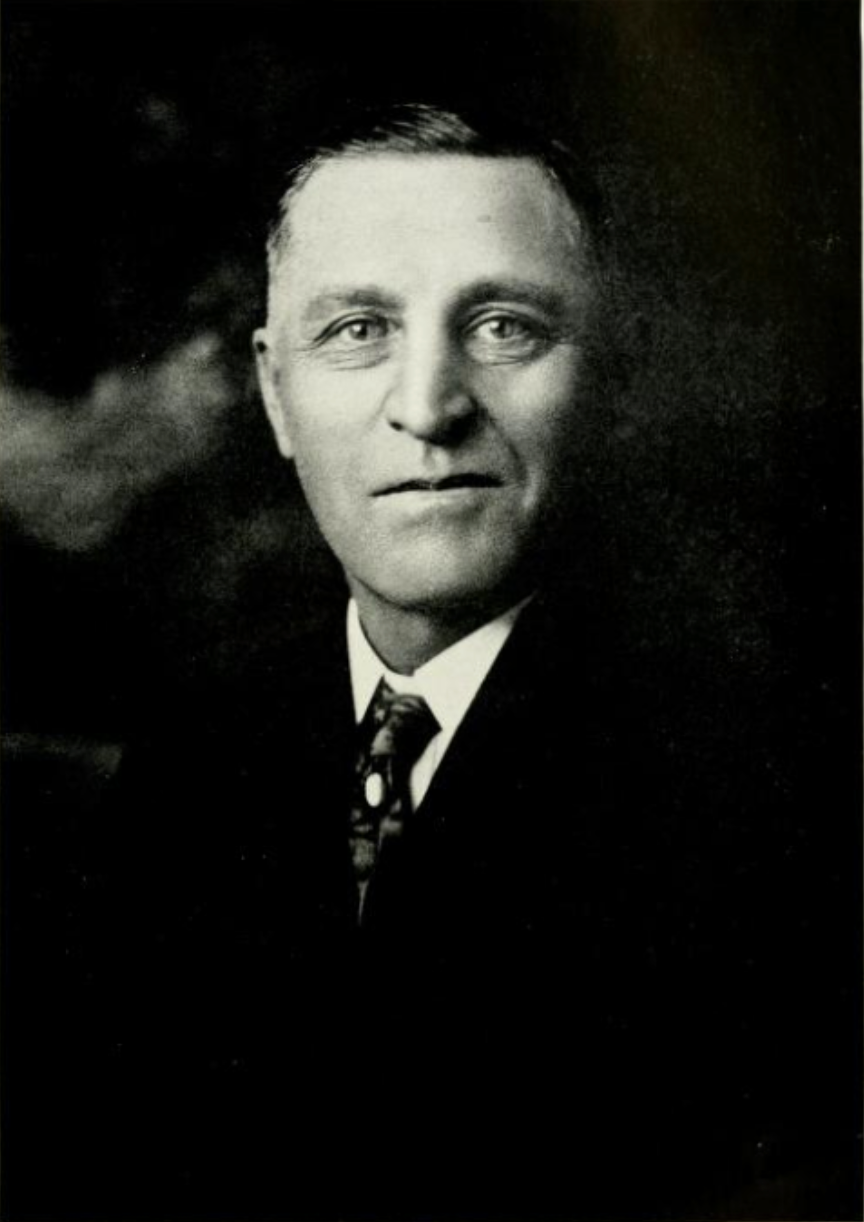
Remington in 1921
March 4, 1897- March 3, 1898
In Office
Preceded by
Succeeded by
Unknown
W S Bartholemew
April ?, 1913 - March 10, 1914
In Office
Preceded by
Succeeded by
William Wearne
John Curran
Preceded by
May 15, 1912 - April ?, 1913
In Office
R. A. Angst
Born
Died
Burial
Spouse
Children
Occupation
Politcal Party
Religion
Clubs
Signature
Clarence A. Remington
May 28, 1859
Lorraine, New York, U. S.
May 5, 1939 (aged 79)
Hibbing, Minnesota, U. S.
Maple Hill Cemetery, Hibbing
Eleanor Kohler
6, including Winfield, Raymond, Margaret, Dorothy, and Katherine
Lumber Dealer
Republican
Catholic
Civic Club
Clarence A. Remington (May 28, 1859 - May 5, 1939) was best known as a local lumberman.
Born on May 28, 1859, in Lorraine, New York, to Daniel J. & Margaret M, he was the second of four. He grew up on his father's farm and, from an early age, was interested in steam engineering; he pursued marine engineering (Van Brunt, 1921). By 20, he held a government license in marine engineering on the Great Lakes. Afterwards, he had his first taste of the lumber industry after his first job as a laborer in Manistee, Michigan, in the late 1870s (Van Brunt, 1921). In 1880, he moved to Minneapolis, Minnesota, where he worked as an engineer in a lumber mill (Polk Directories 81-84)(1880 Census). He first lived at 823 3rd Avenue NE for the first couple of years before moving to 101 10th Street SE for the remainder of his time there. In 1885, he moved to Waconia, Minnesota, originally to build and install boilers in steamboats with his partner Andrew F. Schutz (The Weekly Valley Herald, 3/12/1885, & 7/2/1885), but the two later built and operated their own lumber mill (The Weekly Valley Herald, 12/23/1886). In Waconia, he met his wife, Eleanor Kohler, and together they got married at the Catholic Church on September 26, 1887 (The Weekly Valley Herald, 10/6/1887). By 1892, they lived in St. Anna, Minnesota, and had bought up lumber mills in the Albany and Avon region. By the winter of 1898-1899, business had been slowly declining (The Weekly Valley Herald, 2/17/1899), so he offically moved to Hibbing on October 20, 1899 (Genealogy Trails), and set up a sawmill on the Power-Simpson Logging Road, close to the Duluth, Missabe, & Northern Railroad, and opened in November (Hibbing News, 9/23/1899). The Schwinghamer Bros Lumber Company purchased all of Remington's properties in the St Anna and Albany region (The Weekly Valley Herald, 11/17/1899).
It wasn't easy at first, as small fires were breaking out across northern Minnesota in 1900; one such had burned the neighboring town of Virginia down. In April of 1900, a fire reached the Remington Mill, but it was quickly put out; the losses were quickly covered by insurance money (The Weekly Valley Herald, 4/27/1900). In July, the rest of his family joined him (Genealogy Trails). By 1903, Remington moved his offices to Third Avenue, where he also built a planing mill for his raw cut wood to be made into finished dimensional lumber (Mesaba Ore, 8/1/1903)(The Weekly Valley Herald, 5/1/1903). Shortly after, he moved his planing mill operation to First Avenue in 1904 to make way for Keheller's Hotel. In 1911, the mine was encroaching on his lumber mill, so he relocated to the southern edge of town on Third Avenue. (1968 Jubilee ). Remington later retired from the business, leaving it to his sons Winfield and Raymond in 1920 before the two split the company, with Winfield moving his operations to South Hibbing in 1927. That same year, he took over the Gopher Journal (No Citation). The two lumber companies later closed in the 1960s, with the South Hibbing mill closing first and the North Hibbing one soon after. This decade marked the end of an era in the history of lumber companies.
Early life and education
Remington House (1116 Third Avenue)
Born
Death
Burial
Occupation
Spouse
Children
Political Party
Religion
Clubs
Signature
Life in Hibbing
May 28, 1859
Lorraine, New York, U.S.
May 5, 1939
Hibbing, Minnesota, U. S.
Maple Hill Cemetery
Lumberman
Eleanor Kohler (m. 1885)
6, including Winfred and Raymond
Republican
Catholic
Civic, Commerical
Heading 1

Remington Family Tree
Maybe not so Fun Fact
On April 11, 1904, C A Remington, his son, Winfred, and a bookkeeper of Remington's, Edward L. Foreman, were arrested for animal cruelty. Earlier, several cows belonging to many citizens of Hibbing including Peter Wring and W. C. Barrett suddenly died within days of each other on the land belong to C A Remington's lumber yard. An investigation ensued and piles of Paris Green poision